
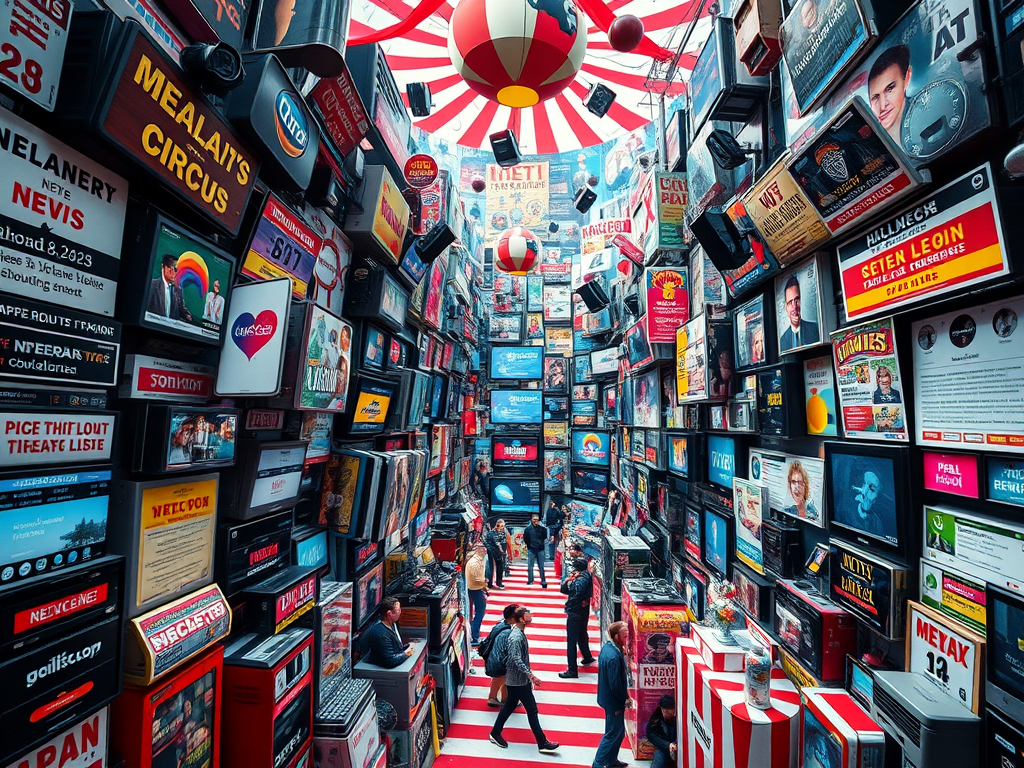
In our media-saturated postmodern world, where communication flows one way—from the powerful to the powerless—it can feel like we’re all just passive spectators, captivated by whatever shiny distraction is thrown our way. Welcome to the grand circus of modernity, where adventure movies, nature shows, celebrity romances, and political scandals swirl around us like fireflies on a summer night—captivating yet fleeting.
Welcome to “Survivor: Media Edition”
Effective February 14, 2025—yes, Valentine’s Day, because nothing says romance quite like a hefty governmental overhaul! The Pentagon has decided to spice things up with its new “annual media rotation program.” Say goodbye to your usual news anchors and hello to a delightful lineup featuring guests like Breitbart and OANN. Who needs roses when you can have conspiracy theories on defense budgets? Imagine Secretary of Defense Pete Hegseth glancing at the traditional press lineup and thinking, “You know what this needs? A little alternative flavor!” It’s as if he’s been binge-watching reality TV and thought, “What if we had a media shake-up where journalists in tinfoil hats take center stage?” Meanwhile, the poor White House Press Corps is relegated to the cheap seats. NBC News and The New York Times—once titans of journalism—are now forced to watch through their binoculars as they sit behind those conspiracy theorists munching on popcorn.
With this wildly disruptive rotation in play, the White House acts as the ultimate puppet master, pulling all the strings and deciding who gets the coveted front-row seat at presidential events. It’s like a high-stakes game of musical chairs—except instead of chairs, journalists vie for a glimpse of the Commander-in-Chief! Thanks for playing, Associated Press; your refusal to embrace the catchy moniker “Gulf of America” has landed you on the bench while less scrupulous outlets bask in glory. At this rate, we might need an elimination round reminiscent of a classic reality show: “Who will survive the cut for next year’s press corps?” Reporters must impress a panel of Trumpers with their best soft-ball questions. Will they make it to next season or face an early exit? Stay tuned!
Carnival of Illusions
When navigating today’s media landscape, you’re constantly surrounded by a bewildering array of wacky distortions and misleading reflections that would leave even the most seasoned magician scratching their heads in utter confusion. This chaotic environment is filled with humorously exaggerated claims and outlandish promises, creating an almost carnival-like atmosphere where nothing seems quite what it appears to be. Yet amidst this delightful chaos lies a gritty truth: finding genuine news has become as challenging as locating a unicorn hidden within this vibrant carnival extravaganza. Indeed, the line between fact and fiction has become blurrier than those wiggly mirrors at funhouses that warp your reflection into something unrecognizable and bizarre. In this perplexing realm of information overload, one cannot help but wonder: is that trending topic we see flashing across our screens a genuine nugget of information worthy of our attention or merely another cleverly disguised piece of propaganda designed to lure us in like moths irresistibly drawn to a flame? Perhaps it’s nothing more than an advertisement showcasing the latest “must-have” gadget that promises to revolutionize your life but ultimately delivers little more than disappointment. In such an environment, distinguishing between authentic journalism and sensationalized content requires not just vigilance but also critical thinking skills. The questions we need to ask ourselves are paramount: Who benefits from sharing this information? What motives lie behind its presentation? With every swipe on our devices or click on our browsers, we must remain discerning consumers of media, equipped with the ability to sift through the noise in search of clarity amid confusion.
Are we being deceived?
Absolutely! And somehow, like moths drawn irresistibly toward a flame (or perhaps more accurately, like children drawn to the promise of cotton candy), we keep coming back for more. It’s as if we’re all under some bizarre spell that compels us to engage with this chaotic circus of information. The spectacle of modern media consumption presents an illusion of choice while simultaneously limiting our actual options. Each headline pulls us in with its tantalizing allure—so sweet it could give you a toothache—and yet often leaves us feeling unsatisfied and craving something more substantial. Just when you think you’ve found something worthwhile, you’re simultaneously pushed away from other sites and news sources like a bouncer at a club who decides you’re not on the guest list anymore. So here we are, navigating this topsy-turvy world with our virtual compasses spinning wildly out of control as we try to discern fact from fiction amidst all the noise.
We secretly become little cogs in this vast, mechanical contraption known as mass media. We’re skewered by shiny advertisements that tantalize us into complicity while simultaneously plunging us into a deep abyss of existential despair! Remember those halcyon days when we all tuned in to the same shows? Back then, it was much more challenging to feel like we were being manipulated by the media. It was a simpler time when our biggest dilemma was whether to watch Friends or Seinfeld during prime time—ah, sweet nostalgia! Fast forward to today’s world, where fragmented audiences reflect societal class distinctions as varied as the algorithms will allow.
Echo Chambers
Now, every individual has access to stream their own unique cacophony of tunes and shows that might be completely different from anyone else’s playlist across the globe. We have more options than ever before, which sounds fantastic, like a kid in a candy store. Ironically, this abundance of choices can leave us feeling more isolated. It’s as if we’re navigating an endless maze of streaming channels tailored for every socio-economic class. Picture this: my wife is engrossed in an obscure documentary about artisanal bread-making—yes, there’s a whole world devoted to crafting sourdough with the perfect crustiness. Meanwhile, I’m sprawled on the couch watching SportsCenter, absorbing the latest scores and highlights as if they were crucial news. The commercials are amusing! They’re completely different worlds; hers features charming hipsters discussing gluten-free alternatives, while mine showcases ads for high-octane energy drinks or trucks that could tow a house. Yet, they seem perfectly tailored to their viewers—like one person’s entertainment is watching dough rise while another’s is watching athletes risk life and limb for a trophy. It’s almost comedic how our viewing habits reflect our lifestyles: her cozy documentary leads to thoughts about sustainability and local farms, while my SportsCenter binge leaves me dreaming of a Red Sox World Series. Amid this cornucopia of choices, we can still feel like strangers on parallel paths. In their quest for consumer dollars, advertisers know they must deliver content faster than ever—or risk being left behind in the digital dust.
We are Only Valued as Consumers
Dollar signs lurk in the shadows, hinting at hidden motives. Whether engaging with “educational material” or influencers promoting fundraisers disguised as self-help, there’s often a layer beneath the surface. Is there a real difference between propaganda, advertisements, and genuine education? In this chaotic marketplace of ideas, we are unwitting consumers navigating persuasive tactics. At first glance, offerings may seem captivating—like shiny objects in a magic show—but beneath the sparkle lies one truth: money. Advertisements and propaganda intertwine to shape social norms while eliciting ironic chuckles at our expense. We get caught up in narratives aimed more at ratings than genuine engagement with reality. As we scroll through feeds, our personal data fuels an algorithmic beast that knows us better than family—capable of predicting our next click! Marketing has evolved into a tailored whisper rather than a desperate shout; those clicks and views reflect not just curiosity but also our value as consumers. It’s a classic case of “you scratch my back; I’ll scratch yours,” leaving everyone with itchy backs and empty wallets!
Slow Detox
What’s the difference between propaganda, advertisements, news, and education? It’s like asking what distinguishes fine wine from manipulated grape juice—plenty, yet sometimes it all ferments into the same bubbling concoction. We watch what they want us to watch, and they sell us whatever they choose. We’re stuck in a dizzying vortex of media consumption, so tantalizingly packaged that we’re all hopelessly addicted! We’re all scrolling down the rabbit hole together with wide eyes. But fear not! A slow detox is indeed possible. Here comes your first step in detox: acknowledgment! The next time you catch yourself mindlessly consuming media, ask yourself—is this an ad disguised as news, or am I being educated while I wait for my favorite show to start? Because spoiler alert: there might be some sneaky overlaps!
Citations and Further Reading
Bennett, W. (2016). News: The Politics of Illusion, Tenth Edition. University of Chicago Press.
Johnson, L. (2025). Pentagon EVICTS dishonest mainstream media outlets, while allowing new media to rotate in. NPR News. https://www.npr.news/2025-02-04-pentagon-evicts-dishonest-mainstream-media-outlets-allows-new-media.html
Stokols, E. (2025). White House seizes control of press pool, will decide which outlets cover events with president. POLOTICO. https://www.politico.com/news/2025/02/25/trump-white-house-press-pool-access-00206001
Zaltman, G. (2003). How Customers Think: Essential Insights into the Mind of the Market. Harvard Business School Press.
 Robert C. McOuat
Leave a comment